Handwriting reference
Different Handwriting Styles
16 font examples, from everyday handwriting to flowing script and bold marker lettering.
Digital font examples, not scans of real handwriting.
Handwriting styles
Loading handwriting fonts...
8 of 16 styles
Print selection: Upright print
Upright print
Patrick Hand / Different Letters
A digital font reference, not a handwriting curriculum or stroke-order guide.
A B C D E F G H I J K L M
N O P Q R S T U V W X Y Z
a b c d e f g h i j k l m
n o p q r s t u v w x y z
0 1 2 3 4 5 6 7 8 9
The quick brown fox jumps over the lazy dog.
Look at the shapes, then write your own version below.
letrasdiferentes.my/en/different-handwriting-styles
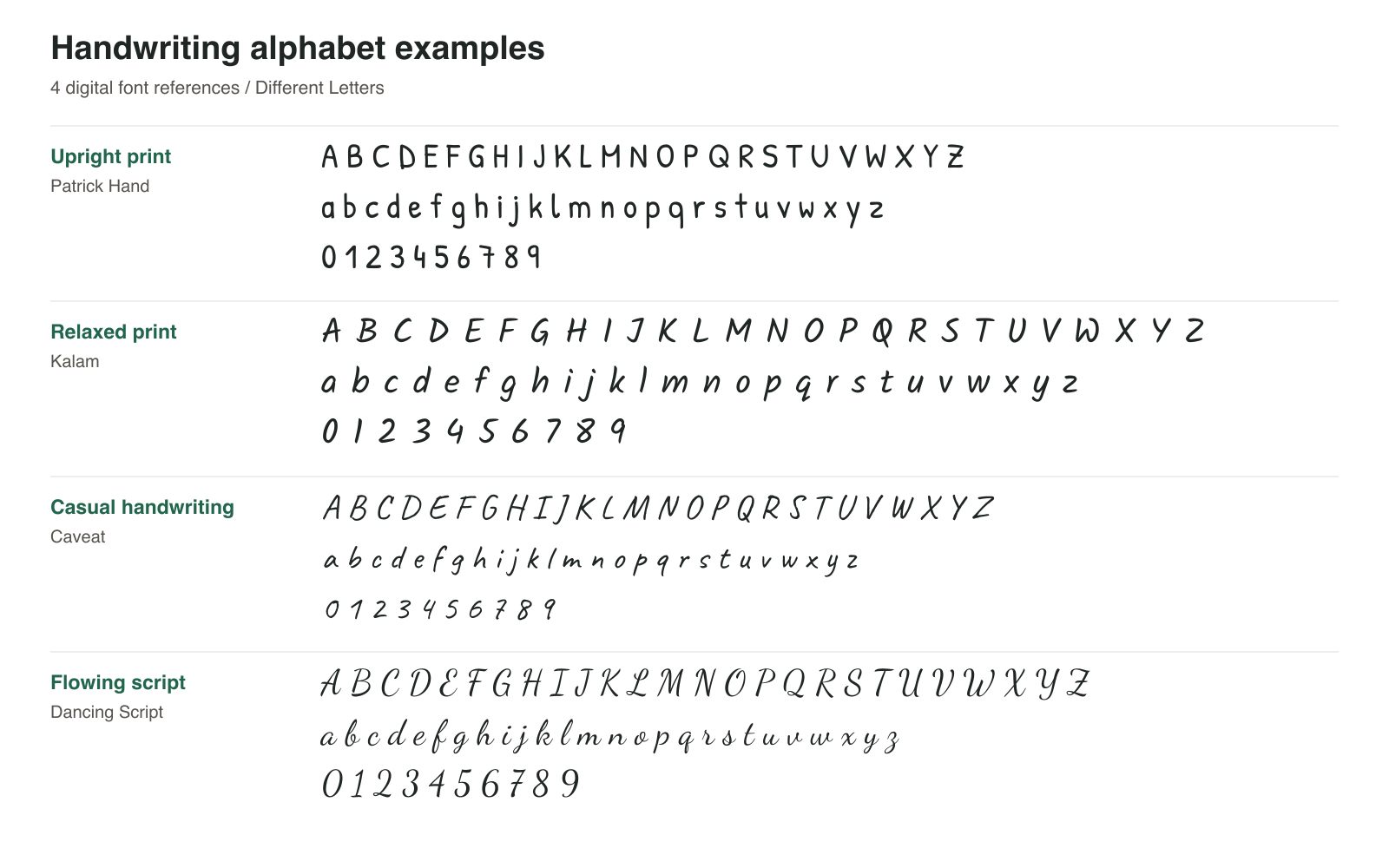
Handwriting alphabet examples
Download all 16 alphabets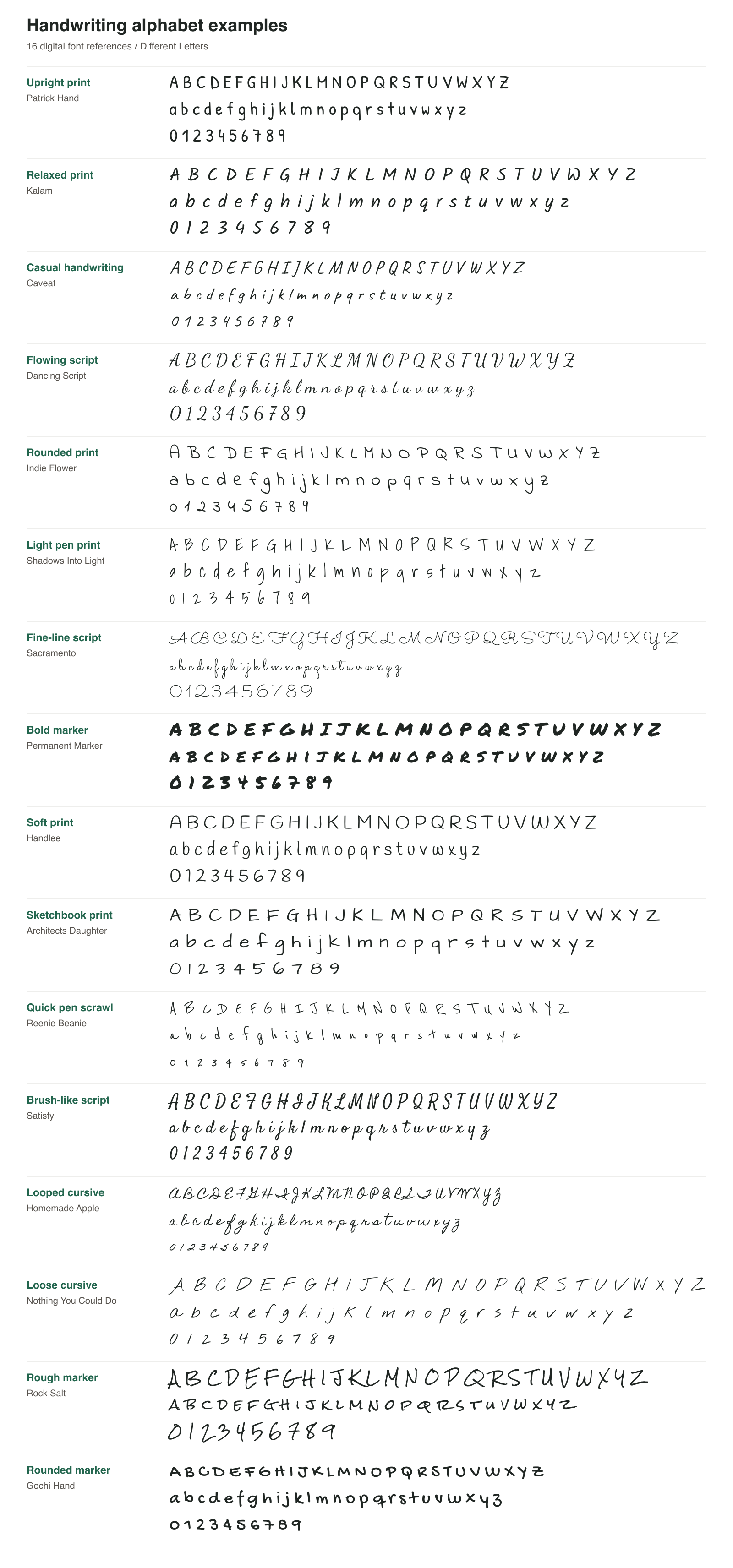
Compare the loops in g and y, the height of t, and the shapes of capitals. An alphabet shows individual letters; a sentence also reveals spacing and connections between them.
What are the main types of handwriting?
Print handwriting: separate, unjoined letters
Letters stand apart rather than joining through a whole word. Compare upright and slanted print: a slant alone does not make a style cursive.
Cursive handwriting: connected letters and flowing strokes
Letters connect through joining strokes. Letter shapes and joins vary between handwriting systems; a decorative script font is not necessarily a model for learning those joins.
Mixed handwriting: a blend of print and cursive
A personal hand can combine joined and separate letters. The aim need not be a perfect category: consistent spacing and recognizable shapes matter too.
Calligraphy and hand lettering are related but distinct practices, with more attention to designed strokes and drawn letterforms. Named teaching systems such as D'Nealian and Getty-Dubay also have specific models; the fonts above do not represent those curricula.
Further reading: Explore Learning's handwriting guide and Handwriting Success's curriculum comparison chart (PDF).
Choose a style for what you write
- Notes and study
- Try a short paragraph, not just your name. Check whether similar letters stay distinct and whether you can read it comfortably the next day.
- Journals and personal letters
- Compare a relaxed print with a more connected hand. Choose shapes that feel comfortable to write repeatedly, rather than copying every flourish.
- Invitations and headings
- A flowing script can give a short line a decorative feel. Keep details such as dates and addresses in an easily readable style.
From a reference to your own handwriting
- Pick a short phrase with a mix of tall letters, short letters, and tails below the line.
- Write it slowly beside the reference. Notice letter size, space between words, and the angle of your strokes.
- Write it again without looking, then compare. Keep one change to work on instead of changing everything at once.
The printed sheet is a visual reference with blank practice lines. It does not teach stroke order or provide tracing instructions. For a school assignment, follow the model your teacher provides.
Need a digital result instead?
A styled image
Font styling does not travel with plain text. A PNG keeps the rendered appearance for a graphic or invitation.
Create a text imageCopy-and-paste cursive
Unicode script uses different characters rather than a font file. It can be pasted into supported apps, but its appearance may change.
Open cursive text converter